MLB Spread Betting UK: Financial Markets and Taxation
 Available in US
I first encountered spread betting on baseball during a conversation with a trader at a City pub. He was not a sports fan — he bet MLB totals the same way he traded index futures: pick a direction, choose a stake per point, and let the outcome determine your profit or loss. The concept felt alien coming from a fixed-odds background, but the more I explored it, the more I recognised it as a powerful tool for bettors who think in terms of magnitude, not just direction. The UK gambling and betting industry generates 17.2 billion pounds in revenue, and financial spread betting occupies a distinctive corner of that market — regulated by the Financial Conduct Authority rather than the Gambling Commission, and carrying tax implications that make it uniquely attractive.
Spread betting on MLB is not for everyone. The potential for losses that exceed your stake introduces a risk profile that traditional fixed-odds betting does not. But for bettors who understand the mechanics and manage their exposure, it offers two advantages no conventional bookmaker can match: the ability to profit in proportion to how right you are, and a tax-free structure that the UK government has so far left intact.
Because financial spread betting carries unique risks, punters should familiarize themselves with UKGC gambling regulations to ensure they are fully protected.
Financial Spread Betting Mechanics for Baseball Markets
The mechanics of a spread bet are fundamentally different from a fixed-odds bet. At a bookmaker, you place 10 GBP on the over at 8.5 total runs, and if the game finishes with 9 or more runs, you win a fixed amount based on the odds. Whether the total is 9 or 19, your payout is the same. Spread betting replaces that binary outcome with a sliding scale.
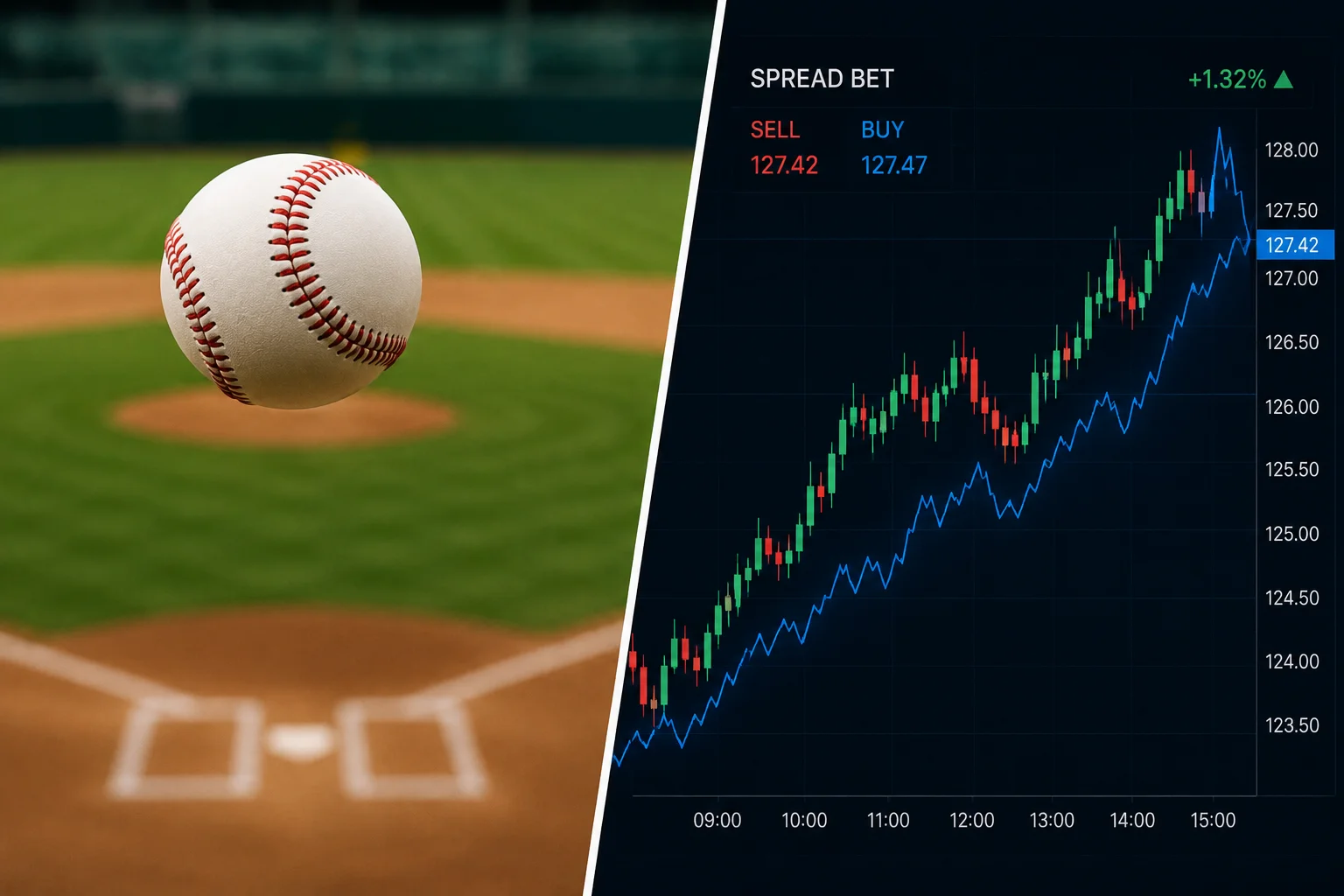
A spread betting firm quotes a spread on total runs — say, 8.0-8.4. If you think the game will produce more runs than the top of the spread, you “buy” at 8.4, choosing a stake per run — perhaps 10 GBP per run. If the game finishes with 11 total runs, your profit is (11 – 8.4) x 10 = 26 GBP. If it finishes with 6, your loss is (8.4 – 6) x 10 = 24 GBP. The further the actual result moves from the spread, the more you win or lose.
This proportional payoff changes the way you analyse games. In fixed-odds totals betting, you only care whether the game goes over or under the number. In spread betting, you care about how far over or under it goes. A game that finishes 12-8 is dramatically more profitable on a “buy” than a game that finishes 5-4, even though both went over 8.5. That distinction makes high-scoring potential — not just scoring direction — the key variable in your analysis.
Spread betting firms also offer markets beyond total runs: total hits, total home runs, total innings runs for individual teams, and even performance indices that combine multiple statistics into a single number. The variety is broader than what most UK bookmakers offer on MLB, which makes spread betting particularly appealing for bettors who want to express a view that fixed-odds markets do not accommodate.
MLB Spread Betting Markets: Runs, Hits, and Innings
The total runs market is the most liquid and most commonly traded MLB spread bet. Provisional UK tax receipts from betting and gaming reached 982 million pounds in the first quarter of 2025-26 alone, up 11% year-on-year, and the competitive pressure among spread firms to offer attractive MLB markets has grown with the broader market expansion. The runs spread typically sits close to the equivalent fixed-odds total, with a 0.2-0.4 run spread width representing the firm’s margin.
Team runs spreads let you bet on one team’s scoring rather than the combined total. If you believe the Dodgers will light up a struggling starter but are less sure about the opposing offence, buying the Dodgers’ team runs at, say, 4.2 at 10 GBP per run gives you exposure to exactly the outcome you expect. If they score 7, you make 28 GBP. If they score 2, you lose 22 GBP. This market is sharper than the full-game total for bettors with a strong view on one side of the pitching matchup.
Hits and home runs spreads are thinner markets with wider spreads, but they offer niche opportunities. A game at Coors Field between two contact-heavy lineups might see the total hits spread set at 18.5-19.5. If you have done your homework on the factors that drive scoring and believe the game will produce 22 or more hits, buying at 19.5 at 5 GBP per hit offers a meaningful payoff. The key is that wider spread widths on these markets mean you need a larger move in your favour to overcome the firm’s built-in edge.
The Tax Advantage of Spread Betting on MLB
This is the section that turns heads. In the UK, profits from financial spread betting are classified as gambling winnings, not capital gains or income. That classification means they are tax-free for the individual bettor. You pay no capital gains tax, no income tax, and file no returns on your spread betting profits. Adam Woodhead, a senior analyst at The Investors Centre, has pointed out that two policy moves are actually widening the spread bet tax advantage through 2026: the CGT annual exempt amount has dropped 76% from 12,300 to 3,000 pounds in two years, and the dividend ordinary rate rises from 8.75% to 10.75% in April 2026. For bettors who might otherwise be trading MLB-related financial instruments or generating investment returns, the spread betting route offers a tax-efficient alternative.
This advantage is not theoretical. A bettor who generates 5,000 GBP in annual profit from MLB spread betting keeps the full amount. The same bettor generating 5,000 GBP from a capital gains-producing activity would owe tax on the portion exceeding the 3,000 GBP annual exempt amount. The differential is modest at small scale but becomes significant as profits grow.
One caveat: HMRC could theoretically reclassify spread betting profits as trading income if your activity resembles a professional trading operation rather than recreational gambling. In practice, this reclassification is extremely rare for sports spread bettors, but it is worth being aware of if your activity scales to professional-level volume. The tax-free status is robust for the vast majority of UK bettors placing MLB spread bets as a supplementary activity.
Maximize your tax-free returns by utilizing the leading baseball betting guide tailored specifically for the UK market.
Managing Downside Risk in Spread Bets
The proportional payoff that makes spread betting attractive also makes it dangerous. A fixed-odds bet has a defined maximum loss: your stake. A spread bet has a theoretical maximum loss that depends on the market’s extreme outcome. If you buy total runs at 8.4 at 10 GBP per run and the game finishes 0-0 (extraordinarily rare in MLB, but not impossible), your loss is 8.4 x 10 = 84 GBP. That is already four times the typical fixed-odds stake on the same game.
Most spread betting firms offer stop-loss orders that limit your downside. A guaranteed stop-loss at a specified level — say, a maximum loss of 50 GBP — adds a small premium to the spread but caps your exposure. I use stop-losses on every MLB spread bet. The premium is worth the peace of mind, especially in a sport where outlier results do happen. A 15-1 blowout or a rain-shortened game can produce spread bet outcomes far outside normal ranges.
Stake sizing is even more critical in spread betting than in fixed-odds wagering. I never stake more than 0.5% of my bankroll per point on a spread bet, compared to 1-2% on a fixed-odds wager. That conservative sizing accounts for the variable loss profile. A bad night on fixed odds costs one unit. A bad night on a spread bet without proper sizing can cost five or ten units — and that kind of drawdown takes weeks to recover from.
Spread betting rewards precision and punishes carelessness. If you are disciplined about stop-losses, stake sizing, and market selection, it provides access to a tax-free, proportional-payoff structure that enhances your MLB betting toolkit. If you skip those safeguards, it amplifies your mistakes just as efficiently as it amplifies your insights. Treat it as a specialist instrument, not a default, and it earns its place in the rotation.
Are MLB spread betting profits really tax-free in the UK?
Yes. Under current UK tax law, spread betting profits are classified as gambling winnings and are exempt from both capital gains tax and income tax. The tax burden falls on the spread betting firm, not the individual bettor. This applies to all sports spread bets, including MLB markets. The exemption is well-established but could theoretically change through future legislation.
What is the maximum loss on an MLB spread bet?
Without a stop-loss, your maximum loss depends on the most extreme possible outcome multiplied by your stake per point. For a total runs buy at 8.5 at 10 GBP per run, a 0-0 game would cost 85 GBP. Guaranteed stop-loss orders, available at most UK spread betting firms, cap your loss at a predetermined level for a small premium added to the spread width. Always use stop-losses on MLB spread bets.