NRFI MLB Betting Strategy: Pitcher and Park Analytics
 Available in US
Three seasons ago I stumbled onto what felt like a cheat code. A friend in New York mentioned he was “hammering NRFIs” – betting that neither team would score in the first inning. I laughed it off as a novelty bet, the kind of market bookmakers throw in to keep punters entertained between innings. Then I tracked the data for a month and realised he was onto something. Certain pitcher matchups produced scoreless first innings at rates well above 70%, and the odds rarely reflected that frequency. By the end of that summer, NRFI bets had become a fixed part of my nightly card.
The appeal for UK bettors is practical: the bet settles fast, usually within fifteen minutes of first pitch, and the research required is narrower than a full-game analysis. You do not need to model bullpen depth, late-inning pinch-hitting, or ninth-inning collapse scenarios. You need two things – how the starting pitchers handle the opening frame and how the opposing lineups perform in their first plate appearances. Each MLB season spans 2,430 regular-season games, so the sample size for first-inning data is enormous. If you approach NRFI betting with discipline rather than dart-throwing, it rewards the preparation.
Analyzing NRFI and YRFI Baseball Betting Markets
The acronyms are simple enough. NRFI stands for No Run First Inning – you are betting that both halves of the first inning end without either team crossing home plate. YRFI is the opposite: Yes Run First Inning, backing at least one run to score before the second inning begins. Most UK bookmakers list these under “1st Inning Specials” or a similar tab within the MLB match page, though availability varies.
What makes NRFI interesting as a market is its binary simplicity paired with genuine analytical depth. Unlike a full-game moneyline where dozens of variables interact over nine innings, the first inning isolates just two matchups: the away team’s top-of-the-order hitters against the home starter, and the home team’s top-of-the-order hitters against the away starter. That narrow window makes research manageable. You are studying six to eight batters per side and two pitchers, not entire rosters and bullpen chains.
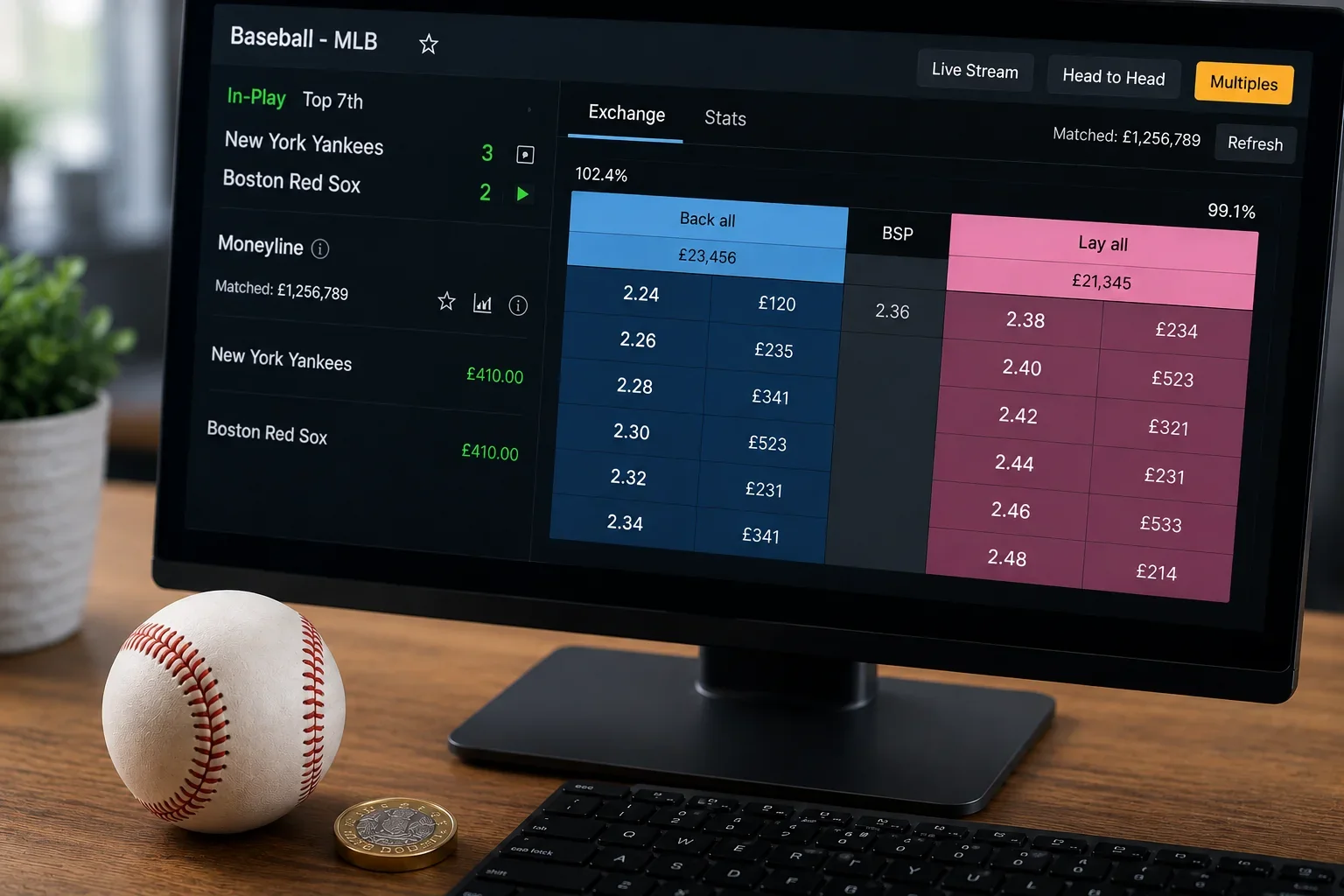
The pricing tends to hover around even money for many matchups, with NRFI often sitting between 1.70 and 1.90 in decimal odds. When two elite starters face off – the kind who routinely record 1-2-3 first innings – the NRFI price can drop to 1.55 or lower, reflecting the market’s confidence that neither offence will score early. Those compressed prices are not always worth backing. The edge, when it exists, lives in the games where the NRFI probability is higher than the odds suggest, and finding those requires digging into first-inning-specific numbers rather than relying on season-long ERA.
Pitcher First-Inning ERA and Lineup Contact Rates
Season-long ERA tells you how a pitcher performs across all innings, but the first inning is a different animal. Some starters are slow to settle – they walk the leadoff man, nibble at corners, and give up hard contact before finding their rhythm in the second or third. Others are metronomically clean in their opening frame, retiring the side on ten pitches and building from there. The gap between these two types is where NRFI value hides.
First-inning ERA is the primary stat I check. Baseball Savant and FanGraphs both break down pitcher performance by inning, and the differences can be stark. A starter with a season ERA of 3.20 might carry a first-inning ERA of 1.80 – meaning he almost never allows runs before the game settles in. Another pitcher with the same overall ERA might sit at 4.50 in the first inning, suggesting he routinely gives up early damage. That second pitcher is an NRFI killer, regardless of his full-game numbers.
On the batting side, you want to examine how the opposing lineup’s top three or four hitters perform in their first at-bat of the game. Contact rate matters more than power here. A lineup loaded with high-strikeout sluggers is actually NRFI-friendly – they swing and miss often, which means fewer balls in play and fewer chances for baserunners. Conversely, a lineup with patient, high-contact hitters at the top of the order – the kind who foul off pitches and work deep counts – creates more first-inning traffic and raises the YRFI probability.
I combine both sides into a rough checklist: if both starters have first-inning ERAs below 3.00 and both opposing lineups rank in the bottom half of the league for first-inning OPS, that game goes on my NRFI shortlist. If only one side of the equation holds, I pass. The beauty of a 2,430-game season is that you never have to force a play – there will be another NRFI candidate tomorrow.
Parks That Favour or Kill NRFI Bets
Venue selection nearly wrecked my NRFI record in 2023. I had backed a clean pitching matchup at Coors Field in Denver without checking the park context. Both starters had sub-3.00 first-inning ERAs. Both opposing lineups struck out at above-average rates. On paper, it was a textbook NRFI. The away team scored two runs before the first commercial break. Coors Field carries a park factor of 1.25 for runs – 25% more scoring than the league average – and that inflation does not politely wait until the middle innings to kick in. The thin air makes pitches flatten out and fly balls carry further from the first pitch of the game.
Not every hitter-friendly park is equally dangerous for NRFIs. Great American Ball Park in Cincinnati, which has produced more home runs than any other venue over the past five seasons with a home run park factor of 1.301, is a genuine threat in the first inning when lineups are stacked with right-handed power. But parks where the scoring bump comes primarily from doubles and triples – like Fenway with its short left-field wall – tend to produce their damage later in games as the lineup turns over and sees the starter a second or third time.
Pitcher-friendly parks are NRFI gold. Oracle Park in San Francisco suppresses home runs for right-handed batters by roughly 21% relative to the league, and its cold marine air in evening games adds another layer of offence suppression. Dodger Stadium, T-Mobile Park in Seattle, and Tropicana Field in Tampa are other venues where first-inning scoring historically runs below league average. When a strong NRFI pitching matchup lands at one of these parks, the probability tips even further in your favour.
My rule is simple: I will not back an NRFI at Coors Field under any circumstances, and I add a mental discount to any NRFI play at the five or six highest-scoring venues. If the rest of the analysis is strong enough to overcome that discount, fine. If not, I skip the game and wait for a matchup at a suppressive park.
A Step-by-Step NRFI Selection Process
The process I follow each afternoon takes about twenty minutes per game, and I rarely end up with more than two or three NRFI plays on any given slate. That restraint is deliberate. The edge in this market is modest per bet, and volume without selectivity erodes it fast.
Step one: pull the day’s starting pitcher matchups. I use the probable pitchers page on any major MLB data site and immediately filter out any game where either starter has a first-inning ERA above 4.00. That alone eliminates half the slate on most days. Step two: check the pitcher stats that matter for betting – specifically first-inning K/BB ratio and first-inning WHIP. A starter who walks batters early is an NRFI liability no matter what his ERA says. Step three: assess the opposing lineup’s top four hitters. I want low first-inning OPS and high strikeout rates in that segment of the order. If both lineups pass the test, the matchup advances.
Step four is the park filter. Any game at a park factor above 1.10 for runs gets flagged. If the pitching matchup is elite – both starters with sub-2.00 first-inning ERAs – I may still consider it at a moderate hitter’s park. At Coors or Great American, the answer is always no. Step five: check the odds. If the NRFI price implies a probability lower than my own estimate, the bet has positive expected value and I place it. If the price is too compressed – say, 1.55 when I model the NRFI probability at 62% – the edge is too thin to justify the risk, and I move on.
The entire sequence is mechanical by design. Emotional betting – “this matchup feels like a scoreless first inning” – has no place in a market this narrow. Either the data supports the play or it does not. That discipline is what separates NRFI bettors who grind a small but consistent profit from those who treat the market like a coin flip with better branding.
When NRFI Meets Variance
Even with a rigorous process, NRFI betting will test your patience. A leadoff batter who barely makes contact can bloop a single, steal second on a wild pitch, and score on a groundout – all within three minutes. You did nothing wrong; the sport simply did what it does. I have had stretches where seven consecutive NRFI bets lost despite every indicator pointing the right way. That is not a broken system. That is a short-term sample in a high-variance market.
The antidote is bankroll discipline. I never stake more than 1-2% of my total bankroll on a single NRFI play. Over a full month, the volume of qualifying games – often fifty or more – smooths out the variance, and the positive expected value reveals itself in the cumulative numbers. If you are betting NRFIs with the expectation of winning every night, you have misunderstood the product. The expectation is to win more than you lose over hundreds of bets, and to do so by a margin that exceeds the bookmaker’s built-in edge.
NRFI is not glamorous. It does not produce the adrenaline of a late-inning comeback or the thrill of a walk-off home run. But for UK bettors who want a structured, data-driven corner of MLB wagering that settles quickly and demands just twenty minutes of daily research, it is one of the most rewarding markets I have found in eight years of analysing this sport.
Is NRFI a profitable MLB betting strategy long-term?
It can be, but only with selective application. Blindly betting NRFI on every game produces roughly break-even results after the bookmaker’s margin. Profitability comes from filtering for low first-inning ERA pitchers, high-strikeout opposing lineups, and pitcher-friendly parks. The edge per bet is small, so volume and discipline matter more than any single play.
Which MLB pitchers have the best first-inning ERA for NRFI?
First-inning ERA leaders change season to season, so checking current data on Baseball Savant or FanGraphs is essential. As a general pattern, high-strikeout starters who rely on fastball command tend to post the cleanest first innings, because they attack the strike zone early rather than nibbling at corners. Any starter with a first-inning ERA consistently below 2.50 across multiple seasons is worth tracking for NRFI plays.