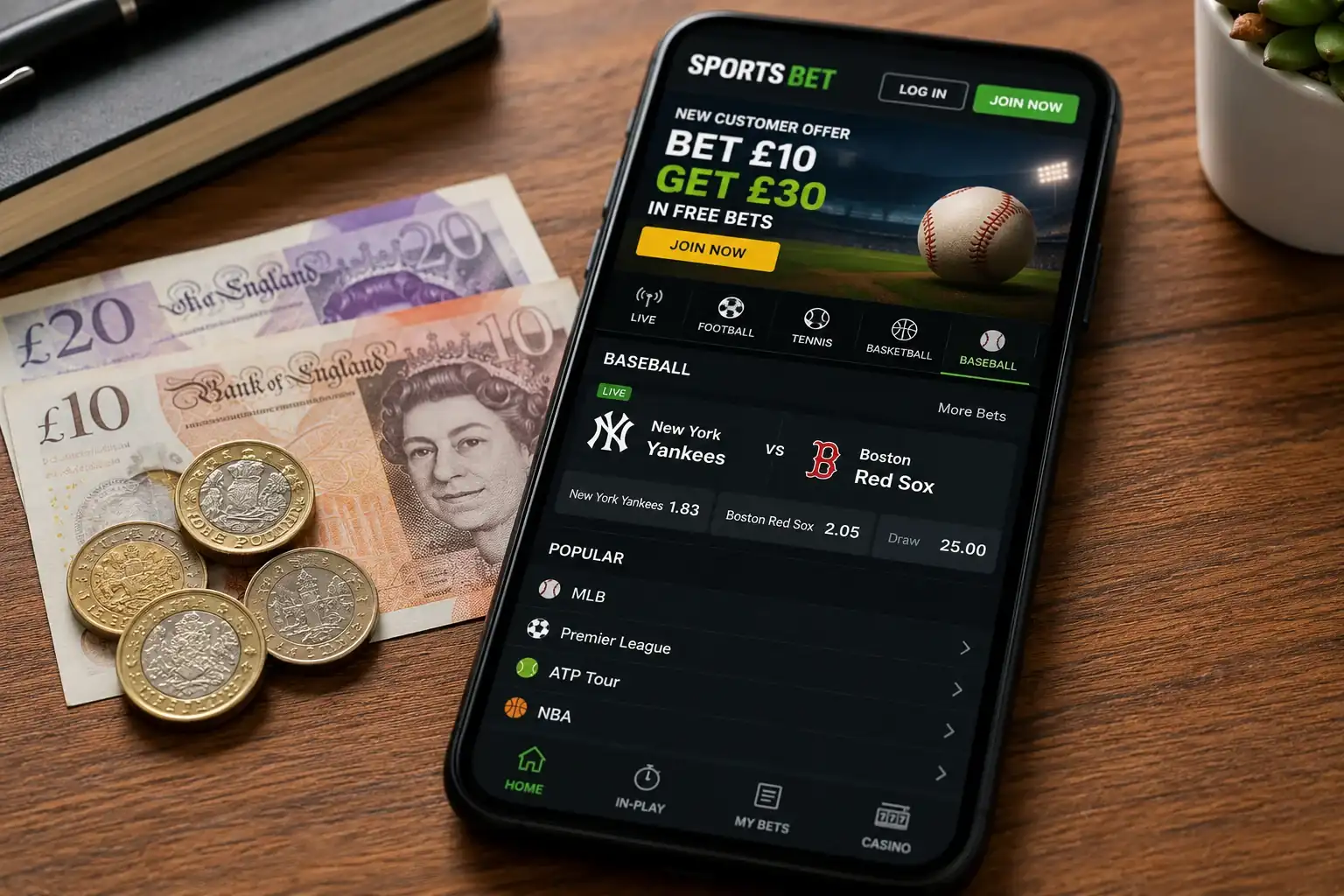
MLB Betting Fundamentals for UK Punters
 Available in US
Table of Contents

I placed my first baseball bet in 2018 from a flat in Clapham, half-watching a Yankees game on a laggy stream at one in the morning. I had no idea what a run line was. I barely knew how many innings made a full game. Eight years later, MLB betting accounts for roughly a third of my annual wagering activity — and I genuinely believe it offers edges that Premier League markets stopped giving up years ago.
Here is why. Every MLB regular season produces 2,430 games across 30 teams, each playing 162 fixtures. That volume creates a daily menu of 15 matches on a typical summer evening — more individual contests than a full Premier League matchweek generates in three days. For a UK bettor already comfortable with football markets, stepping into baseball means stepping into a sport where data is absurdly abundant, underdogs win roughly 44% of the time, and bookmakers on this side of the Atlantic are still learning how to price it properly.
Around 10% of the UK adult population actively bets on sport online, yet barely a fraction touches baseball. That is partly cultural — baseball is not a mainstream sport here — but it also means the educational gap is wide. This guide exists to close it. I will walk you through the rules of the game itself, the three bet types you will use most often, how to read a betting slip in decimal odds, and how to avoid the mistakes I made when I started. No prior knowledge of baseball required.
Core Baseball Rules and Match Structures for Bettors
A friend once asked me to explain baseball in the time it takes to order a pint. I failed spectacularly — the bartender had to bring the second round before I finished. But the core mechanic is simpler than most people assume, and you genuinely do not need to grasp every nuance to bet intelligently.
Two teams take turns batting and fielding. The batting side sends one player at a time to home plate, where they try to hit a ball thrown by the opposing pitcher. If the batter reaches base safely and eventually touches all four bases — first, second, third, home — their team scores a run. Three outs end a team’s turn at bat. Both teams bat once per inning, and a standard game lasts nine innings.
Think of it like a cricket match compressed into a tighter format. Instead of overs, you have innings. Instead of a bowler, you have a pitcher — and the pitcher’s role is arguably more decisive than any single player in any other major sport. A dominant starting pitcher can single-handedly suppress the opposing lineup for five, six, sometimes seven innings before handing off to relief pitchers (the bullpen) to finish the game.
There is no clock. A game can theoretically go on indefinitely if the score is tied after nine innings, though extra-inning rules introduced in recent years have shortened those situations. Most games last between two and a half and three and a half hours. For UK bettors, that means an evening game starting at 00:10 or 01:10 BST will usually wrap by 03:30 — not ideal for sleep, but manageable if you pick your spots.
The absence of draws is the single biggest structural difference from football. Every baseball game produces a winner. That binary outcome simplifies the betting market considerably: you are always choosing between two sides, not three.
Scores tend to be low by the standards of other American sports. A typical MLB game finishes somewhere around 4-3 or 5-2. Blowouts happen — especially when a weak pitcher faces a strong lineup — but one-run and two-run margins account for a hefty proportion of outcomes. This compression matters for betting: small margins mean small advantages in information can translate into genuine edges.
Each team fields nine players on defence and sends those same nine to bat in a fixed order called the lineup. The lineup is not confirmed until a few hours before the game, and managers frequently rotate players based on whether the opposing pitcher throws left-handed or right-handed. Those platoon decisions ripple directly into the betting lines, which is why you should never place a bet before lineups are posted.
Moneyline Bets: Picking the Winner
The first MLB bet I ever placed was a moneyline. I did not know it had a name at the time — I just picked the team I thought would win. That instinct was correct, because the moneyline is the simplest and most popular baseball market: you back one side to win the game outright, full stop.
In decimal odds — the default at every UK-licensed bookmaker — a moneyline price tells you exactly what you get back per pound staked. If the New York Yankees are priced at 1.65 and you put down 10 pounds, a win returns 16.50 (your original stake plus 6.50 profit). The opposing team might sit at 2.35, meaning a tenner returns 23.50 if they pull off the upset.
Baseball moneylines behave differently from football match-result markets in one critical way. Underdogs win far more often. Across a full MLB season, the team priced as the underdog wins approximately 44% of all games — roughly four out of every nine. Compare that to the Premier League, where away underdogs might win 25-30% of the time, and you start to see why baseball attracts sharp bettors. The margins between good and bad teams are narrower than in most sports, because even the best lineup in baseball fails to get a hit about 70% of the time. A single well-pitched game from an underdog’s starter can neutralise a significant talent gap.
One practical note: MLB moneylines are heavily influenced by the announced starting pitcher. If the listed starter is scratched before first pitch, most bookmakers void the bet and return your stake. Always check whether your bookmaker operates on “listed pitcher” or “action” rules — listed pitcher means your bet only stands if both named starters actually take the mound.
Run Line Bets: Baseball’s Version of a Spread
If you have ever placed an Asian handicap bet on a football match, you already understand the run line. The concept is identical — one team gets a virtual head start, the other a virtual deficit — but in baseball, the standard handicap is almost always fixed at 1.5 runs.
Here is how it looks in practice. Suppose the Los Angeles Dodgers are strong favourites, priced at 1.40 on the moneyline. That price offers very little return for the risk involved. The run line alternative might show Dodgers -1.5 at 1.85 and their opponents +1.5 at 1.95. Backing the Dodgers at -1.5 means they need to win by two or more runs for your bet to land. Backing the underdog at +1.5 means they can lose by a single run and your bet still wins.
The -1.5 run line on a favourite is one of the most popular secondary markets in MLB betting. It boosts the price significantly compared to the flat moneyline, and in games where you expect a dominant pitching performance or a lineup mismatch, the extra juice is worth the additional risk. Conversely, the +1.5 on an underdog is an excellent defensive play: even if the dog loses, it only needs to keep the game close.
Some bookmakers also offer alternate run lines at -2.5 or +2.5, though availability varies among UK operators. The wider the spread, the higher the price on the favourite side and the lower on the underdog side. I tend to stick with the standard 1.5 for most regular-season bets and only venture into alternates during postseason or lopsided matchups.
One thing that trips up newcomers: the run line applies to the full game, including extra innings. If a game goes to the tenth and the favourite wins 5-4, their -1.5 backers lose. The final margin is what counts, not the margin after nine.
Totals (Over/Under): Betting on Runs Scored
Totals work exactly the way goals over/under works in football, just with higher numbers. The bookmaker sets a line for the combined runs scored by both teams, and you decide whether the actual total will go over or under that number.
A standard MLB game total sits somewhere between 7.0 and 10.0 runs, with 8.5 being a common default for an average matchup. The line shifts based on three main factors: the starting pitchers (two aces facing each other pushes the total down), the ballpark (some stadiums are notorious run factories), and the weather (hot days and wind blowing out to centre field inflate scoring). A game at Coors Field in Denver, which sits at altitude and inflates run scoring by roughly 25% compared to the league average, will routinely carry a total of 10.5 or higher. A game at a pitcher-friendly venue like Oracle Park in San Francisco might open at 7.0.
I find totals appealing precisely because they remove the need to pick a winner. You are betting on the nature of the game, not the outcome. That distinction matters psychologically and analytically. When I started, I noticed I was better at identifying whether a game would be high-scoring or low-scoring than I was at picking winners — and the data bore it out. If you develop a feel for pitching matchups and park effects, totals can be a consistent source of value.
A quick worked example: the game total is set at 8.5, priced at 1.91 for both over and under. You have analysed the starters and believe the game will stay low. You place 10 pounds on the under. If the final score is 3-2 (five total runs), your bet returns 19.10. If the final score is 6-4 (ten total runs), you lose your 10 pounds. Simple as that.
Half-runs in the line (8.5, 9.5) eliminate the possibility of a push — a drawn result on the total. If the line were set at a whole number like 9.0 and the game finished with exactly nine runs, your bet would be voided and the stake returned. Most MLB totals use half-run lines to avoid this.
Parlays and Same-Game Parlays in MLB
Parlays — or accumulators, as we tend to call them in the UK — combine multiple selections into a single bet. All legs must win for the parlay to pay out, and the combined odds multiply together to produce a larger potential return from a smaller stake.
In MLB, parlays are attractive because the daily schedule hands you so many options. On a busy summer Tuesday, 15 games might be on the slate. Threading three moneyline picks into a parlay at average prices of 1.80 each produces combined odds of roughly 5.83 — a tenner returns 58.30. The catch, obviously, is that one wrong pick sinks the entire ticket.
Same-game parlays (SGPs) are a newer product that has reshaped how recreational bettors interact with baseball. An SGP lets you combine selections from the same match — say, the Dodgers to win, the game total to go over 8.5, and a specific batter to record two or more hits. The bookmaker prices this as a single combined bet, adjusting the odds to account for the correlation between legs.
That correlation adjustment is where the bookmaker’s edge lives. Two legs that naturally go together — for instance, backing the over on total runs and backing a high-powered offence to win — are not truly independent events. The bookmaker knows this and prices the SGP accordingly, often building in a heftier margin than you would get betting each leg separately. I use SGPs sparingly, mostly for entertainment value on nationally televised games, rather than as a core part of my strategy.
One structural note for UK punters: not every bookmaker licensed by the Gambling Commission offers SGPs on baseball. The feature is more common on operators with US-facing platforms. Check your bookmaker’s MLB coverage before assuming SGP availability — it varies widely.
Placing Your First MLB Bet at a UK Bookmaker
Billy Walters, one of the most successful sports bettors alive, once remarked that British bookmakers still do not fully understand how to price American sports. That gap has narrowed since he said it, but it has not closed — and for a UK punter opening an account for the first time with baseball in mind, it creates opportunity.
The process itself is straightforward. You need an account with a bookmaker licensed by the UK Gambling Commission. If you already bet on football, you almost certainly have one. Navigate to the baseball or MLB section — sometimes filed under “American sports” or “US sports” — and you will see a list of today’s games with moneyline, run line, and totals markets.
Odds will default to decimal format, which is the most intuitive for calculating returns. Multiply your stake by the decimal price: that is your total return including the original stake. If you see a moneyline price of 2.10 and you wager 20 pounds, a win pays 42 pounds back to your account. The profit is 22 pounds. No mental gymnastics required.
Here is the practical sequence I follow for every MLB bet. First, I check the confirmed starting pitchers — lineups are typically released four to six hours before first pitch. Second, I compare the odds across at least two bookmakers. The average US sportsbook holds about 10.15% margin on the combined odds of a baseball game, and UK operators tend to sit in the same range, sometimes a touch wider on less popular leagues. Shopping even one bookmaker against another can gain you two or three points on the decimal price, which compounds across a full season of bets.
Fund your account in GBP to avoid currency conversion fees. Most UK bookmakers settle baseball bets in sterling regardless of the sport’s home currency. Minimum stakes on MLB tend to mirror whatever the bookmaker’s minimum is across all sports — usually one or two pounds.
290 million online bets are placed monthly across UK operators. Adding MLB to your portfolio simply means tapping into a different slice of that market, with different rhythms and a different analytical framework than the football you already know.
Five Mistakes New Baseball Bettors Make
Every error on this list is one I made personally. Some of them cost money. All of them cost time. If I could hand my 2018 self a checklist before that first late-night Yankees bet, these five points would be on it.
The first mistake is treating favourites as safe bets. In football, the top-four sides win at home with depressing reliability. In baseball, the best team in the league will still lose 60 or more times across a season. Backing heavy favourites at short prices — anything below 1.45 — is a slow leak on your bankroll because the implied win probability at that price demands a success rate that even elite teams rarely sustain. Be comfortable with underdogs. Understanding how implied probability works in practice will sharpen this instinct considerably.
Second: ignoring the starting pitcher. I cannot overstate this. The starting pitcher is the single most important variable in any baseball game. A team’s win probability can swing by 15 percentage points depending on who is on the mound. Before you place any MLB bet, know both starters and at least glance at their recent form — earned run average (ERA) over the last three to five starts is a decent starting metric.
Third: betting too many games. The 162-game schedule is both a gift and a trap. Having 15 matches a night tempts you into placing eight or ten bets per day, which is a fast track to overexposure. I now cap myself at two to three bets on a heavy day and zero on days where nothing meets my criteria. The volume is there to be selective, not to be busy.
Fourth: neglecting the time zone. MLB evening games start between 23:00 and 01:10 BST. West Coast games can begin as late as 02:10. If you are betting live, that means staying up deep into the early hours. Make sure the bet is worth the sleep you are sacrificing. For pre-match bets, place them in the afternoon or early evening UK time, after lineups are confirmed but before you need to think about bedtime.
Fifth: failing to track results. A football bettor might place 40 wagers across a Premier League season. An MLB bettor who engages with the sport regularly might place 300 or more between April and October. Without a simple spreadsheet recording each bet — date, teams, market, odds, stake, result — you have no way to evaluate whether your approach is working. I started tracking in year two and immediately spotted that my totals bets were profitable while my parlays were bleeding money. That one insight reshaped my entire approach.
Do I need to understand baseball to bet on it?
You need the basics — innings, runs, outs, and the role of the starting pitcher — but you do not need to be a lifelong fan. Most successful UK baseball bettors I know learned the sport through the betting itself. Start with moneyline bets, watch a few games, and the tactical layers will reveal themselves naturally over a few weeks.
What is the easiest MLB bet type for beginners?
The moneyline. You pick which team wins, and that is the entire bet. No spreads, no point calculations, no draw option. Once you are comfortable with moneylines, move on to totals and then the run line.
How long does a baseball game last and when are results settled?
Most games last between two and a half and three and a half hours. Results are settled at the end of the game, including extra innings if the score is tied after nine. For UK bettors, a typical evening game starting at 00:10 BST will be settled by around 03:00.
Can I combine MLB bets with other sports in a parlay?
Yes. Most UK bookmakers allow cross-sport accumulators. You can combine an MLB moneyline pick with a Premier League result or a tennis match winner. Just be aware that each additional leg reduces the probability of the whole parlay landing, and the bookmaker margin compounds with every selection you add.
Created by the ”” editorial team.