MLB Moneyline Betting: Match Winner Odds Analysis
 Available in US

I placed my first MLB moneyline bet in 2019, a midweek game between two teams I barely knew. The appeal was instant: pick the winner, collect the payout. No spreads, no complicated totals – just one question. Will this team win tonight? Seven years later, the moneyline remains the bread and butter of my baseball wagering, and it is the single best entry point for any UK punter discovering MLB for the first time.
The moneyline bet strips baseball down to its essence. You back one team to win the game outright, at whatever decimal odds the bookmaker offers. There is no margin of victory to worry about, no total runs to calculate. If your side wins 1-0 or 14-3, the result is the same for your bet slip. For a sport where underdogs win roughly 44% of all games – a rate far higher than in football or basketball – that simplicity hides some genuinely interesting edges.
This guide walks through how moneyline prices are built, why blindly backing favourites is a losing strategy in baseball, and when the moneyline gives you better value than the run line alternative. Every example uses decimal odds and GBP stakes, because that is what you will see on your screen at any UKGC-licensed bookmaker.
When backing heavy favorites offers little value, shifting your focus to the MLB run line spread can yield much better potential payouts.
Bookmaker Pricing Algorithms for MLB Moneyline Odds
A colleague once asked me why two baseball teams playing each other on consecutive nights can have completely different moneyline prices. The answer sits on the mound. Starting pitchers drive moneyline odds more than any other single factor in professional sport, and because rotations cycle every five days, the same matchup on Tuesday night looks nothing like the one on Wednesday.
Bookmakers begin building a moneyline by modelling each team’s win probability. They feed in the starting pitcher’s recent form – ERA, strikeout rate, walk rate – alongside the opposing lineup’s splits against left-handed or right-handed pitching. Home-field advantage gets a small weight, typically around 54% for the home side in a neutral matchup. Then the model spits out a raw probability, say 58% for Team A.
Converting that probability into decimal odds is straightforward: divide 1 by the probability. A 58% chance becomes 1.72 in decimal. The other side, at 42%, becomes 2.38. But bookmakers do not offer those true prices. They shave a margin – the overround, or “vig” – into both sides. The average sportsbook hold in the United States sits at 10.15%, meaning roughly 10p of every pound staked goes to the house over time. UK-licensed operators tend to run tighter margins on MLB than their American counterparts, partly because baseball is a lower-liability sport here.
The practical result is that both sides of a moneyline add up to slightly more than 100% in implied probability. If Team A is offered at 1.67 and Team B at 2.30, the implied probabilities are 59.9% and 43.5% – totalling 103.4%. That 3.4% is the bookmaker’s edge. Knowing how to spot it, and how to compare it across operators, is the first real skill of moneyline betting.
When Betting the MLB Favourite Backfires
Last June I watched a punter on a betting forum celebrate a “safe” ten-leg moneyline accumulator – all MLB favourites, all priced between 1.40 and 1.60. He needed every single one to land. Four won. The other six? Three lost outright, and three more never even held a lead. His confidence came from football logic: the better team usually wins. In baseball, “usually” means something very different.
MLB underdogs win about 44% of games across a full season. That is not a quirk of a single year – it has held steady across decades of data. Home underdogs are even more dangerous to fade, winning at a 45.9% clip. Compare that to the Premier League, where the away underdog wins perhaps 25-28% of the time, and you begin to see why importing football instincts into baseball is expensive.
The mechanics of baseball explain this. A dominant starting pitcher can single-handedly suppress a superior lineup for six or seven innings. A three-run home run in the second inning puts a heavy favourite on the back foot before the game has found any rhythm. And because MLB uses no clock, a trailing team always has the same number of outs remaining to mount a comeback – there is no running down the clock, no parking the bus.
Heavy favourites – teams priced below 1.50 in decimal – are especially treacherous. The payout is thin, but the risk is not. I have tracked my own MLB bets since 2020 and found that blindly backing any favourite below 1.45 produces a negative ROI over a full season, even though those teams win more often than not. The margin you collect when they win does not compensate for the hit when they lose. It is a maths problem, not a knowledge problem, and it catches newcomers every April.
Finding Value on Moneyline Underdogs
Not every underdog is worth your money, obviously. The trick is distinguishing between a team that is losing because it is genuinely bad and a team that the market is undervaluing because of a short-term narrative – a losing streak, a recent blowout loss, or a less glamorous pitching matchup.
I look for three signals before backing an MLB moneyline underdog. First, the starting pitcher. If the underdog’s starter has a FIP (Fielding Independent Pitching) below 4.00 and has been pitching at least five innings deep into recent starts, the foundation is solid. A competent starter keeps the game close, and close games are where underdog value lives. Second, I check the opposing pitcher’s last three outings. If the favourite’s ace is coming off a rough stretch or pitching on short rest, the market may not have adjusted enough. Third, divisional context matters. Teams within the same division face each other 19 times a season, and familiarity erodes the favourite’s edge – divisional underdogs over the past decade have won at a 48.1% rate with a 7.2% ROI on the moneyline.
The numbers reward patience, not aggression. I rarely back more than one or two underdog moneylines on a given night. The 162-game season is a marathon, and the edge compounds slowly. Placing ten underdog bets a night because the prices look juicy is the fastest way to torch a bankroll.
Read our comprehensive reviews to find the safest MLB betting operators licensed by the UK Gambling Commission.
Moneyline or Run Line: Which to Choose
This is the question I get asked most by UK bettors who have spent a few weeks watching baseball: “should I take the moneyline or the run line?” The honest answer is that it depends on the game, but there is a useful rule of thumb I have settled on over thousands of bets.
The moneyline is your friend when the game projects as close – when neither side is a heavy favourite and the total is set at 8.0 or below. In low-scoring, tightly matched contests, a single run often decides the outcome, and the run line’s 1.5-run spread punishes you for backing a team that wins by exactly one. If you believe a team will win but cannot confidently say they will win by two or more, the moneyline is the cleaner play.
The run line makes more sense when you are backing a strong favourite against a weak opponent, especially when the total is set at 9.0 or higher. In those spots, the favourite’s moneyline price is compressed – maybe 1.35 or 1.40 – and the run line offers a meaningful bump in odds for a margin of victory that blowout-prone matchups deliver more often than the market implies.
I split my baseball bets roughly 60/40 between moneyline and run line over a typical season. The moneyline accounts for most of my underdog action and tight-game plays. The run line handles the spots where I want to back quality at a better price. Neither is universally superior, but knowing when to reach for which tool is what separates a structured approach from guesswork.
The Bet Slip Is Simpler Than You Think
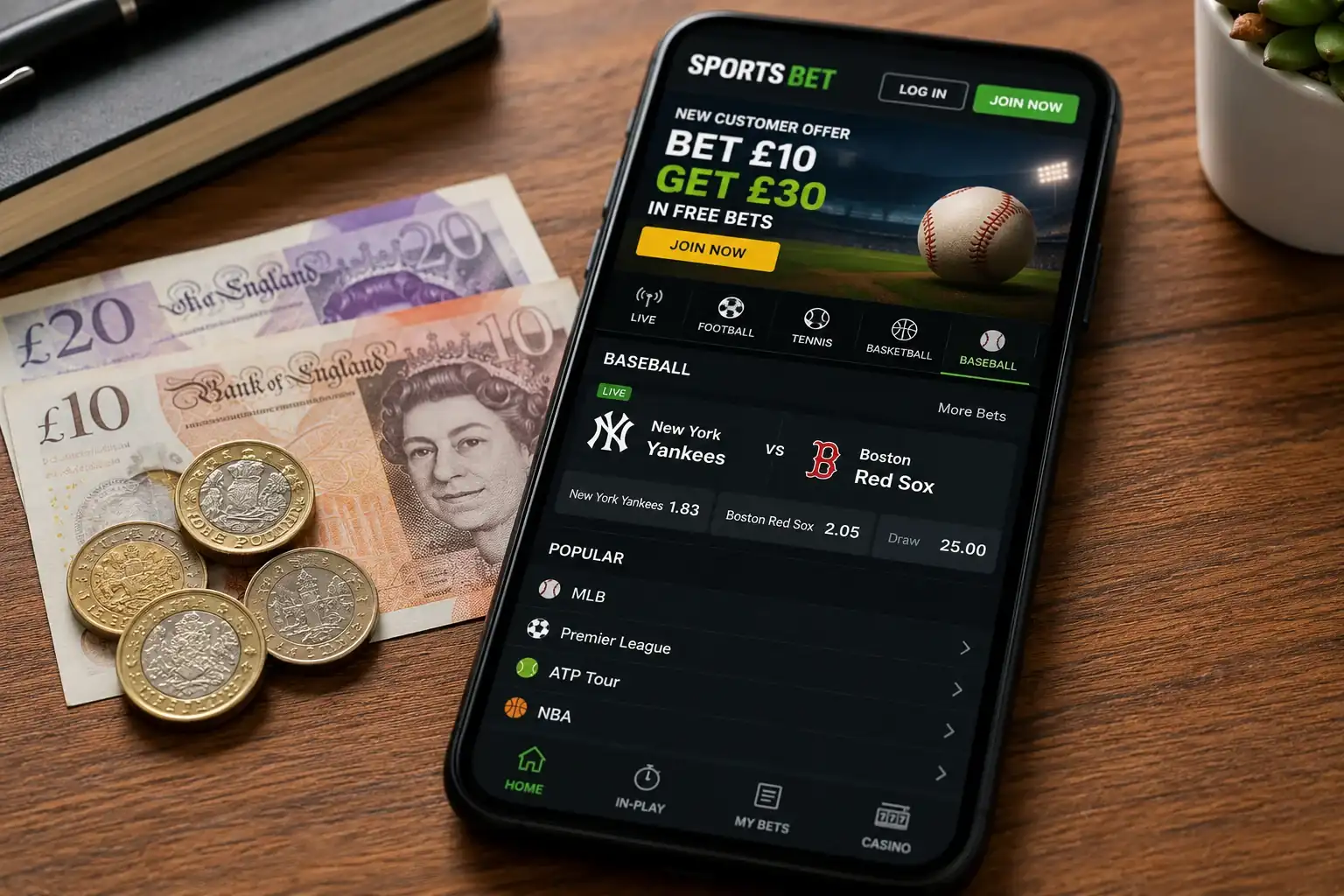
If you have ever backed a football match result, the MLB moneyline will feel immediately familiar. Open your bookmaker’s baseball section, find the game, and you will see two decimal prices next to two team names. Tap the side you want, enter your stake in pounds, and the potential payout calculates itself. A 10 GBP bet at 2.25 returns 22.50 GBP if the team wins – 10 GBP of that is your original stake, 12.50 GBP is profit.
One detail worth noting: MLB moneyline bets are typically graded on the game’s final result, including extra innings. There is no draw outcome in baseball. If the game goes to the tenth, eleventh, or fifteenth inning, your bet stays alive until someone wins. That is a genuine advantage over football accumulators, where a draw can wreck a coupon even when “your” team dominated.
Start with single moneyline bets rather than parlays. Baseball’s inherent unpredictability – that 44% underdog win rate again – makes multi-leg accumulators far harder to land than they appear. A single, well-researched moneyline bet on a game you have genuinely analysed will teach you more in one evening than a ten-fold acca built on gut feeling. The moneyline is simple by design. Your job is to make your selection process anything but.
Why are MLB moneyline favourites less reliable than in football?
Baseball underdogs win roughly 44% of all games, compared to around 25-28% for away underdogs in the Premier League. A single dominant starting pitcher can neutralise a superior lineup, and the absence of a game clock means trailing teams always have the same number of outs to stage a comeback. These structural features make favourites far less dependable than in football.
Should I always take the moneyline underdog at plus odds?
No. Underdog value is selective, not universal. The strongest historical edges come from home underdogs and divisional underdogs, where familiarity and crowd support narrow the gap. Blindly backing every underdog produces marginal results at best. Focus on games where the starting pitching matchup, park context, and divisional dynamics genuinely favour the shorter-priced side.