MLB Betting Account Limits and Bookmaker Restrictions
 Available in US
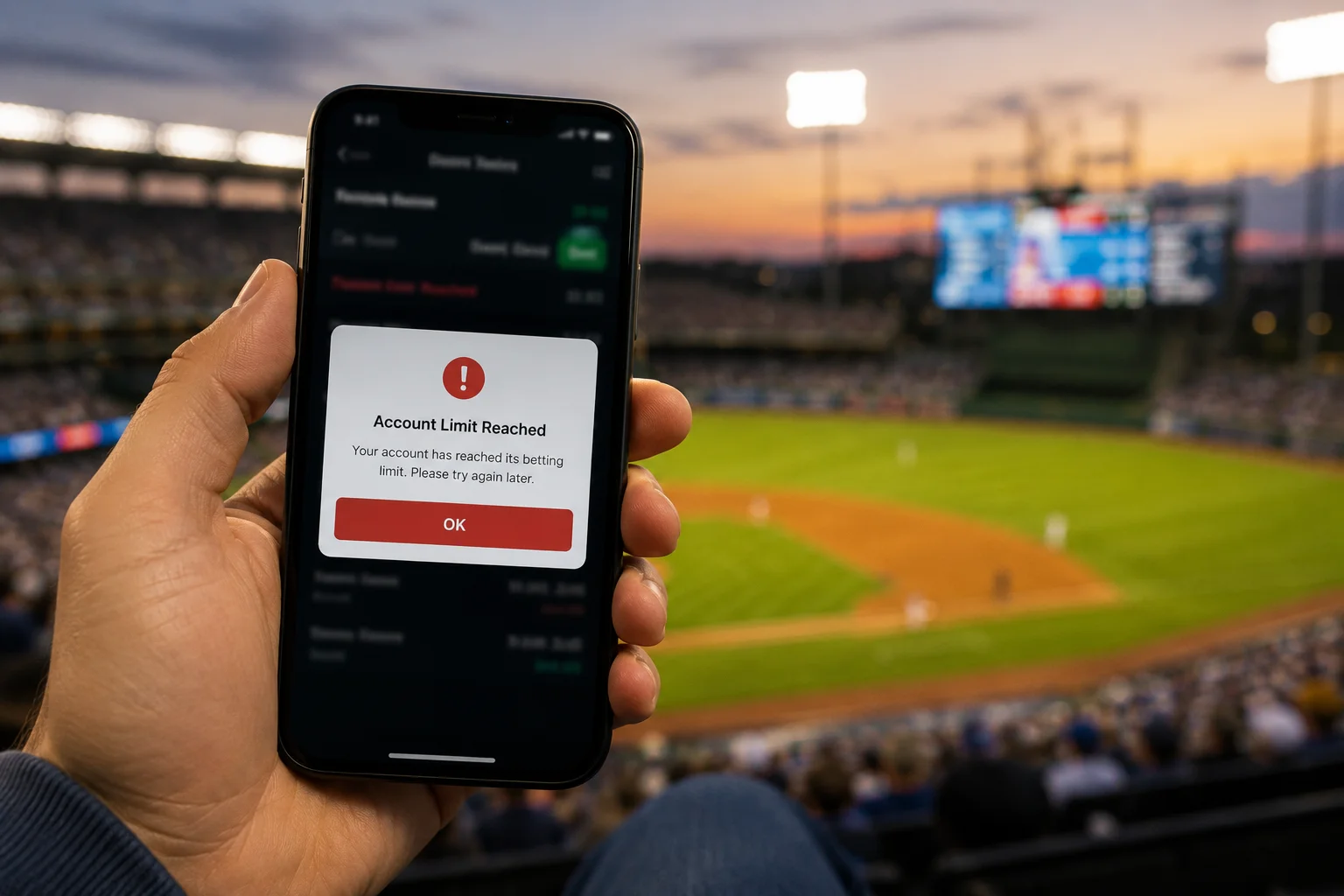
The email arrived on a Thursday afternoon: “Following a review of your account, we have made changes to the maximum stakes you may place.” No explanation, no warning, no appeal offered. My stake limit on MLB moneyline bets had been cut from 200 GBP to 8 GBP. I had been betting baseball profitably for about fourteen months, and the bookmaker had decided that profitable was a problem. That experience — shared by roughly 4% of all UK betting accounts, according to Gambling Commission data, which found 643,779 accounts out of approximately 15 million subjected to some form of restriction — is one of the most frustrating realities of being a sharp bettor in this country.
Account limiting, colloquially known as “gubbing,” is not a glitch or a customer service failure. It is a deliberate commercial strategy. Bookmakers exist to generate profit, and customers who consistently beat the closing line represent a direct cost to the business. Understanding why it happens, how to recognise the warning signs, and what your options are afterwards is as much a part of MLB betting strategy as analysing pitching matchups.
Reasons UK Bookmakers Restrict Winning Baseball Accounts
A bookmaker’s margin on an MLB game might be 4-6% on a moneyline market. If you are winning at a rate that exceeds that margin — say, producing a 3% ROI on volume over several months — you are costing the bookmaker money on every bet you place. The bookmaker’s risk management team tracks your performance not by checking your P&L statement, but by comparing your bets to the closing line. If you consistently bet at prices that move against you less than the market moves against other bettors, you are flagged as “sharp.” Once flagged, the restriction is usually swift.
MLB accounts are particularly vulnerable to limiting because baseball is a lower-volume, lower-visibility sport in the UK. A bookmaker’s MLB desk might handle a fraction of the turnover of its football desk, which means even modest sharp action is proportionally larger and easier to identify. The Gambling Commission’s own data shows that 62.7% of restricted accounts have stake limits imposed — meaning you can still bet, but at amounts so small that the exercise becomes pointless. The Commission has stated clearly that businesses may take commercial decisions to limit accounts provided they do not discriminate on the basis of protected characteristics, and that being a successful bettor is not a protected characteristic. In other words, the law allows it.
The triggers I have observed — from my own experience and from conversations with other sharp baseball bettors — follow a pattern. Frequent betting on underdogs at early morning prices that later shorten. Consistent withdrawal activity relative to deposits. Staking patterns that align with closing line value rather than recreational patterns. And betting primarily on MLB and other niche US sports where the bookmaker’s edge is thinner and the sharp pool is smaller. If your account profile ticks several of these boxes, the restriction is a matter of when, not if.
Warning Signs That Your Account May Be Limited
The first sign is usually not the email. It is the subtle changes to your account that happen days or weeks before the formal notification. Your bet acceptance starts taking longer — where it used to be instant, you now get a “referred to a trader” delay of thirty seconds to two minutes. That delay is the bookmaker checking your bet against their liability and deciding whether to accept it at the offered price.
Promotional exclusions are another early indicator. You stop receiving free bet offers, boosted odds notifications, or opt-in promotions. Bookmakers do not waste marketing spend on customers they are about to restrict. If your inbox goes quiet while every other bettor is getting World Series specials, your account is on a watchlist.
The most reliable warning sign is price sensitivity. Place a moneyline bet at your normal stake and check whether the odds change immediately after your bet is accepted. If you bet 50 GBP on an underdog at 2.60 and the price drops to 2.50 within minutes, the bookmaker has identified your action as informed. That price movement is the market reacting to your bet specifically, not to general market forces. Once a bookmaker is moving its line in response to your individual bets, the stake restriction usually follows within weeks.
I also watch for selective restrictions. Some bookmakers will limit your stakes on MLB while leaving your football betting untouched. If you suddenly find that your MLB moneyline maximum has dropped while your Premier League maximum is unchanged, the message is clear: they have identified baseball as the sport where you generate your edge, and they are protecting their position on that specific market.
What to Do After Getting Gubbed
The initial frustration is real. You have done the work — studied pitching, tracked line movements, built a repeatable process — and your reward is a maximum stake of 5 GBP on a sport you have invested hundreds of hours analysing. The UKGC conducted approximately 9,700 compliance actions in 2024-25, but account limiting is not among the practices it penalises. Bookmakers are within their rights, and the regulator has shown no appetite for changing that position.
So what are your practical options? The first is to move to exchanges. Betfair, Smarkets, and other exchange platforms do not limit winning accounts because their revenue comes from commission on matched bets, not from the margin on losing ones. The liquidity on MLB may be thinner than what you are used to at a bookmaker, but the absence of stake limits means your edge can scale with whatever the market will absorb.
The second option is to diversify across multiple bookmaker accounts. If one operator limits you, others may not have flagged your activity yet — particularly if your betting pattern varies across platforms. Spreading your action reduces the visibility of your overall performance at any single operator and can delay the inevitable restriction. This is not evasion; it is the same multi-operator approach that any sensible bettor employs for line shopping.
The third option is to accept the restriction and focus your bookmaker accounts on promotional extraction — using free bets and enhanced odds at stakes the operator still permits — while routing your serious baseball wagering through exchanges. This hybrid approach treats limited bookmaker accounts as a source of supplementary value rather than the primary vehicle for your MLB strategy.
Building a Restriction-Resistant Betting Approach
You cannot prevent limiting entirely if you are a winning bettor. But you can delay it. Avoid betting exclusively on underdogs at early-morning prices — mix in some favourite bets, some totals, and some props to create a profile that does not scream “sharp.” Place bets at varying times rather than always hammering the opening line. Use round stake amounts (10, 20, 50 GBP) rather than precise calculations (17.43 GBP) that suggest a model-driven approach.
None of these tactics guarantee immunity. A bookmaker’s risk team will eventually catch up if you are consistently profitable. But the delay matters — every month of unrestricted access at a high-volume bookmaker is a month of compounded edge. If you can stretch that window from six months to eighteen months through profile management, the additional value is substantial.
The broader lesson from account limiting is that the MLB betting ecosystem in the UK is not a level playing field. Bookmakers welcome recreational bettors and restrict informed ones. That asymmetry is frustrating, but it is also a signal: if you are good enough to be limited, you are good enough to find value elsewhere. The exchange, the multi-operator spread, and the promotional extraction strategy are all responses to a system that penalises competence. Adapt to the system, and the edge survives the restriction.
Is it legal for UK bookmakers to limit my MLB betting account?
Yes. UK bookmakers are legally permitted to limit or close accounts for commercial reasons. The Gambling Commission has confirmed that being a profitable bettor is not a protected characteristic under discrimination law. Operators must communicate restrictions clearly, but they are not required to justify the commercial decision or offer an appeal process.
Can I appeal an account restriction with the UKGC?
The UKGC does not intervene in commercial decisions about stake limits. However, if you believe the restriction was applied unfairly — for example, without any communication or in a way that breaches the operator’s own terms — you can escalate through the bookmaker’s complaints procedure and then to the Alternative Dispute Resolution service. The ADR can review whether the operator followed its own processes, though it cannot compel a bookmaker to reinstate full account access.