UK Baseball Exchange Betting: Lay Odds and Commissions
 Available in US
The first time I placed an MLB bet on an exchange rather than a bookmaker, the difference felt like stepping from a shop where someone sets the price to an open market where you negotiate your own. Research on exchange profitability suggests that peer-to-peer betting gives you roughly a 40% chance of being profitable, compared to about 2% at traditional bookmakers. Those numbers are not guarantees — they reflect the structural advantage of lower margins and the ability to set your own odds. For UK bettors who have been wagering on baseball exclusively through conventional bookmakers, exchanges open a fundamentally different way of engaging with the sport.
Exchange betting is well-established in UK horse racing and football. On baseball, the model works identically in theory but plays out differently in practice, primarily because of liquidity. MLB is a niche sport in the UK market, and that niche status shapes what you can and cannot do on an exchange. Understanding those limitations before you deposit is the difference between finding genuine value and staring at an order book that nobody is filling.
Comparing Baseball Exchanges Against Traditional Bookmakers
At a traditional bookmaker, the house sets the odds, takes the other side of every bet, and bakes a margin into the price. That margin — the overround, or vig — is how the bookmaker guarantees a profit regardless of the outcome. The average sportsbook hold in the US sits at 10.15%, and UK operators typically run slightly tighter on baseball but still embed a meaningful edge into every line.
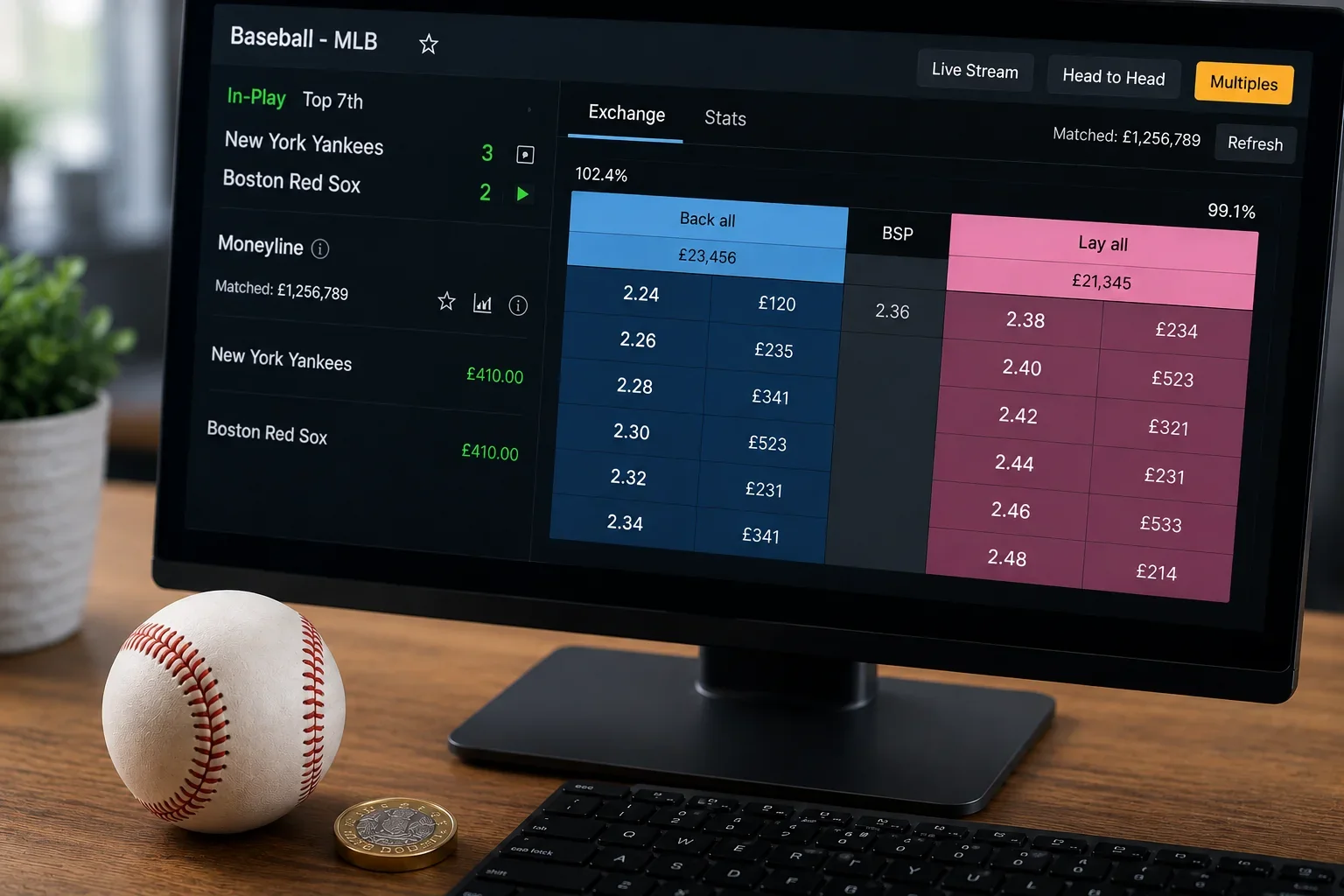
An exchange removes the house from the equation. Instead, you bet against other punters. One person backs a team to win; another lays the same team, effectively betting against it. The exchange takes a commission on winning bets — typically 2% to 5% depending on the platform and your volume — but does not set the odds. The odds are determined by supply and demand: if more money wants to back a team than lay it, the price shortens. If nobody wants to lay at your desired price, your bet sits unmatched until someone takes the other side.
The practical result is tighter effective margins. On a football match with heavy exchange liquidity, the back-lay spread might add up to a 1-2% overround, compared to 5-8% at a bookmaker. That difference compounds over hundreds of bets into a significantly lower cost of doing business. For MLB, the principle holds, but the magnitude depends entirely on how much money is flowing through the market on any given game.
The other structural advantage is that exchanges do not limit winning accounts. A bookmaker who sees you consistently beating the closing line will restrict your stakes, sometimes down to pennies. Account limiting affects roughly 4% of UK betting accounts, and profitable MLB bettors are disproportionately targeted. On an exchange, your winnings come from other bettors, not the platform, so the exchange has no incentive to restrict you. You can bet as much as the market will absorb.
MLB Liquidity on UK Exchanges: What to Expect
Liquidity is the single biggest variable in exchange betting on baseball. A Premier League match might have millions of pounds available in the back-and-lay order book. An MLB regular-season game between two mid-table teams on a Tuesday night in June might have a few hundred pounds — or less. The depth of the market determines how much you can actually bet at the price you see, and for niche sports like baseball in the UK, that depth is often shallow.
World Series games and high-profile playoff matchups attract significantly more exchange liquidity. I have seen six-figure pools on World Series games at Betfair, with tight spreads that rival a bookmaker’s best MLB offerings. But those moments are the exception. During the regular season, expect to find better liquidity on games involving major-market teams — the Yankees, Dodgers, Red Sox — and thinner markets on smaller-market matchups.
Timing matters too. Liquidity builds as the game approaches. If you check an exchange market twelve hours before first pitch, you might see almost nothing matched. Three hours out, the order book starts to fill. An hour before, the serious money arrives. I typically place my exchange bets in the final sixty to ninety minutes before first pitch, which gives me access to the deepest available pool while still locking in a price before sharp action narrows the margins further.
For stakes above 100-200 GBP on regular-season games, you may find that the exchange cannot absorb your full bet at a single price. In those cases, you either split the wager across price levels — accepting slightly worse odds on part of the stake — or use the exchange for the portion you can fill and route the remainder to a bookmaker. Hybrid strategies that combine exchange betting for value and bookmaker betting for volume are common among experienced MLB bettors in the UK.
Lay Betting on Baseball: Practical Applications
The ability to lay — to bet against a team winning — is the feature that most clearly distinguishes exchange betting from traditional wagering. At a bookmaker, if you think a team will lose, your only option is to back the other side. On an exchange, you can lay the team directly, which sometimes offers a better price because the back-lay spread is not symmetrical.
The Gambling Commission has noted that businesses may take commercial decisions to restrict accounts provided they do not discriminate on the basis of protected characteristics, and that being a successful bettor is not a protected characteristic. That ruling means bookmakers can — and do — limit sharp MLB bettors. The exchange side-steps this entirely: nobody can limit you because the platform does not care whether you win or lose. Its revenue comes from commission, not from the margin embedded in prices.
I use lay betting most often in two scenarios. First, when a heavy MLB favourite looks overpriced. Rather than backing the underdog at odds I find unappealing, I lay the favourite — effectively saying “this team will not win” — and collect if the underdog pulls the upset. The lay price is often tighter than the corresponding back price on the underdog, giving me a better effective entry point. Second, I lay teams in live markets when a game scenario shifts against them — a starter pulled early, a key reliever unavailable, a defensive error that opens the floodgates. Live lay betting on MLB is fast, volatile, and requires sharp judgment, but the edges can be substantial when the in-play market lags behind what you are seeing on screen.
When Exchanges Beat Bookmakers on Baseball
Exchanges are not universally better. If liquidity is thin and the back-lay spread is wide, you may get a better effective price at a bookmaker with competitive MLB odds. The exchange advantage is clearest in three situations: when you are a winning bettor who faces account restrictions at bookmakers, when you want to trade positions in-play rather than simply bet and wait, and when you need to lay a team that the bookmaker does not offer on the opposing side at a fair price.
For UK bettors who are new to MLB wagering, I would suggest starting with traditional bookmakers for simplicity and switching to exchanges once your volume and skill level justify the additional complexity. The exchange rewards discipline, patience, and a willingness to accept that your bet may not be fully matched at the price you want. That trade-off is worth it for profitable bettors. For recreational punters, the bookmaker’s fixed price and guaranteed liquidity are often the more practical choice.
Is there enough liquidity to bet MLB on Betfair?
For major-market teams, playoff games, and the World Series, liquidity is generally adequate for stakes up to several hundred pounds. Regular-season games between smaller-market teams can be thin, with limited amounts available in the order book. Liquidity builds in the final 60-90 minutes before first pitch, so timing your bets closer to game time improves the chances of getting matched at your desired price.
What commission do exchanges charge on baseball bets?
Standard commission rates range from 2% to 5% on net winnings per market, depending on the platform and your trading volume. Some exchanges offer reduced commission for high-volume users. Even at 5%, the effective margin is typically lower than the overround built into a bookmaker’s MLB odds, making exchanges more cost-efficient for bettors who consistently find value.